
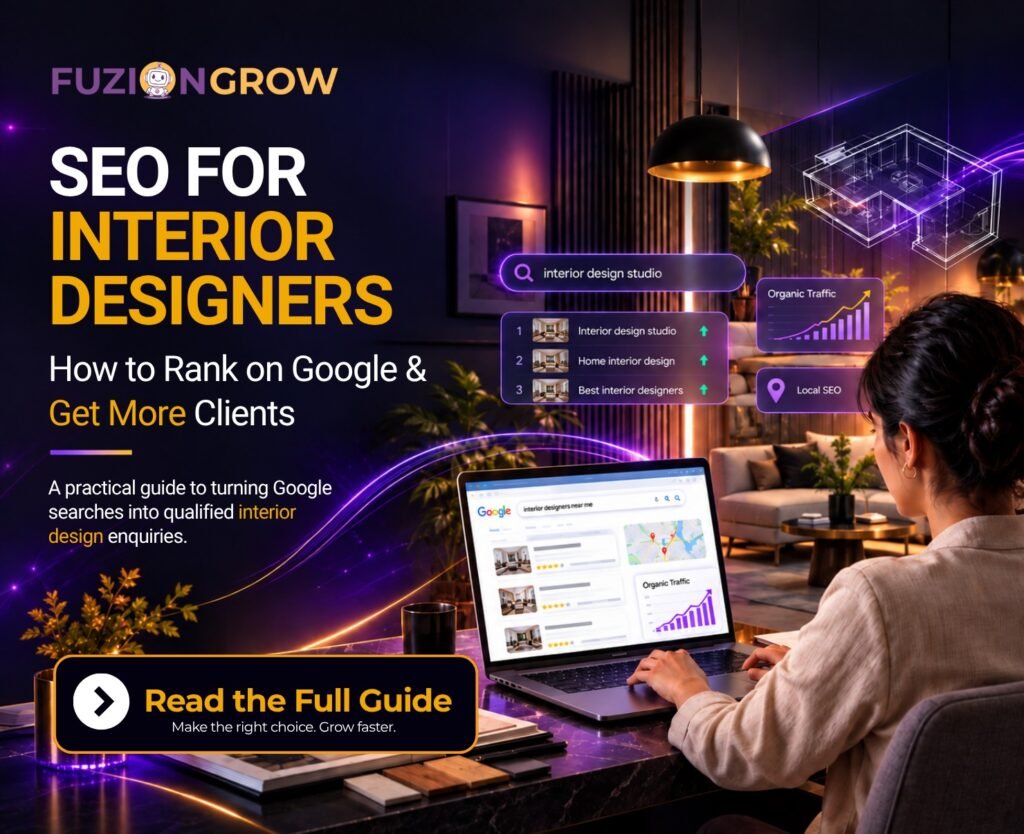
A homeowner searching Google for an interior designer near me, a home interior designer in Bangalore, or a 3BHK interior designer is already looking for professional help. SEO for interior designers helps your studio appear during these high-intent searches, making it easier for potential clients to discover your services, review your projects, check your credibility, and contact your team.
The customer journey usually looks like this:
Google Search → Google Maps → Service Page → Portfolio → Reviews → Enquiry
A well-designed website is valuable, but it cannot generate consistent enquiries if potential clients cannot find it. A focused interior designer SEO strategy improves visibility for the services, project types, and locations that matter to your business.
SEO for interior designers helps interior design businesses rank for relevant Google and local searches, attract people actively looking for design services, and turn search visibility into qualified enquiries.
SEO for interior designers is the process of improving your website, Google presence, service pages, portfolio content, and local visibility so people searching for interior design services can find your business.
For example, an interior design studio may want to appear for searches related to:
Residential interior design
Apartment and 2BHK/3BHK interiors
Villa interior design
Modular kitchen design
Office and commercial interiors
Home renovation services
Interior designers in specific locations
A strong interior design SEO strategy connects these services with the exact searches potential customers use.
It also helps Google understand:
What services you offer
Which locations you serve
What type of projects you handle
Which portfolio pages are relevant
What questions your website answers
Good SEO does not mean repeating the same keyword on every page. Each important page should answer a clear search need and give potential clients enough information to decide whether your business is relevant to their project.
For a broader understanding of search optimization, read our guide on how SEO works in 2026.
For an interior design company, however, the main goal is simple:
Be visible when the right customer is actively searching for the interior design service you provide.
Interior designers can get clients through referrals, Instagram, networking, paid advertising, Google Search, Google Maps, directories, and partnerships.
But search is different from many awareness channels.
Someone scrolling through an interior design reel may simply be looking for inspiration.
Someone searching:
“residential interior designer near me”
is showing a much clearer need.
That person may already have:
That is why search visibility can be valuable for an interior design company.
A good search journey can look like this:
Customer searches on Google → sees your business → checks your services → views completed projects → reads reviews → contacts your team.
Your website should support every part of that decision.
Good interior design SEO therefore does more than send people to your homepage. It helps them reach the page that best matches what they need.
A person searching for office interiors should find relevant commercial work. A homeowner searching for a modular kitchen should not have to search through unrelated projects before finding your kitchen services.
The easier you make that journey, the easier it becomes for visitors to trust your business and enquire
Choosing the right SEO keywords for interior designers starts with understanding search intent.
Do not simply choose the keyword with the highest search volume.
Ask a better question:
What is the person searching for, and how close are they to hiring a designer?
Here is a practical way to separate keyword intent:
Search Intent | Example Search: |
Local | interior designer in Bangalore |
Near me | interior designer near me |
Service | residential interior designer Bangalore |
Project | 3BHK interior designer Bangalore |
Cost | how much does an interior designer cost |
Research | how to choose the right interior designer |
These searches should not all lead to the same page.
Searches such as:
usually need strong service and location pages.
Potential customers may search based on the type of property they own.
Examples include:
These can be supported with detailed service pages and relevant project examples.
Customers also research before they are ready to hire.
Useful interior design SEO keywords can come from questions such as:
The right strategy uses these different searches together.
Informational content brings potential clients to your website earlier. Service and local pages help convert people who are closer to making a decision.
For many interior design businesses, the competition is local.
A homeowner in Bangalore usually wants a designer who can work on a project in Bangalore. Someone planning an office interior in Chennai may prefer a company familiar with local vendors, contractors, project sites, and service areas.
This makes local SEO for interior designers especially important.
Google states that local search results are mainly influenced by relevance, distance, and prominence. Complete business information, reviews, links, and other signals can help Google understand and evaluate a local business.
A practical local strategy should connect several elements.
Keep important information accurate:
Do not add keywords unnaturally to the business name. Keep your information accurate and consistent.
If you genuinely serve different areas, create useful pages explaining your services in those markets.
Avoid creating twenty nearly identical pages where only the city name changes.
A useful page should contain real information about:
A potential customer comparing three interior design companies wants reassurance.
Real customer reviews can provide that proof.
Ask customers to describe their genuine experience rather than giving them a keyword-filled review template.
Your Google Business Profile should not work separately from the website.
Service pages, project pages, reviews, contact details, and local information should support the same clear business identity.
Quick insight:
Someone searching “interior designer near me” usually has stronger local service intent than someone searching “interior design ideas.” That difference should shape your local SEO strategy for interior designers.
Interior design websites have one major advantage: they usually have strong visual material. They also have one common weakness.
A portfolio page may contain fifteen beautiful photographs and almost no useful text.
A visitor can see the room, but Google gets very little context about the project. Instead of uploading photographs alone, turn important projects into useful case-study pages.
A good portfolio page can explain:
For example, instead of creating a page called:
“Project 18”
create something clear such as:
“3BHK Contemporary Apartment Interior Design in Whitefield”
Then explain the actual project naturally.
Images also need attention. Google provides specific image SEO guidance and recommends making images easy to discover and placing them on useful landing pages.
Use descriptive image information where appropriate.
Instead of:
IMG-2837.jpg
use a meaningful file name related to the real image.
Alt text should describe what the image shows. Do not turn alt text into a list of SEO keywords.
This combination makes interior designer SEO stronger because the portfolio becomes both visual proof for customers and useful context for search engines.
Many interior design companies make one of two content mistakes.
They either publish nothing, or they publish only broad inspiration posts such as “Top Interior Design Trends.”
Those articles can have value, but they often miss questions customers ask while deciding whether to hire a designer.
Look at the questions from the customer’s point of view:
This person is actively searching for options.
Create content that explains what to check: location, services, portfolio relevance, reviews, project process, and consultation.
Cost is one of the biggest doubts before an enquiry.
You do not always need to publish one fixed price. Explain what changes the cost, such as property size, scope, materials, custom furniture, kitchen work, and project complexity.
Help customers compare designers based on:
Answer the real questions clients may be nervous about asking.
For example:
This topic addresses fear and builds trust.
You can explain warning signs such as unclear scope, unrealistic promises, no written process, weak communication, or reluctance to explain costs.
These topics are useful because they represent different stages of the buyer journey.
They also make content more suitable for search features, answer engines, and AI-assisted research because each section answers a clear question directly.
That is much stronger than publishing random articles just to reach a monthly blog target.
A successful SEO for interior designers campaign does not need to start with fifty tasks.
Start with the areas that can affect qualified visibility first.
Find the services people search for and match them with the areas your business actually serves.
Avoid targeting every possible city.
Each important service should clearly explain:
Work on your Google Business Profile, business information, genuine reviews, important local pages, and service-area relevance.
Turn your strongest projects into detailed proof.
Do not hide your best work inside a basic image gallery.
Create useful content around costs, hiring, timelines, design process, preparation, mistakes, and project decisions.
Rankings matter, but they are not the final goal.
Track:
Google visibility → organic visitors → service-page visits → calls/forms → qualified enquiries
A keyword ranking that generates no relevant business may be less valuable than a lower-volume keyword that consistently produces good enquiries.
You can handle some SEO work internally.
For example, your team can update project photographs, request customer reviews, improve project descriptions, and answer common client questions.
Hiring an SEO agency may make sense when:
Do not choose an agency because it promises “Page 1 rankings.”
Instead, ask how it will connect keyword research, service pages, local SEO, content, technical work, portfolio pages, tracking, and enquiries.
If you are currently comparing providers, read FuzionGrow’s guide on how to choose the right SEO agency before making a decision.
Interior design SEO needs more than a list of keywords.
The website has to connect search intent with real services, locations, portfolio proof, customer questions, and conversion paths.
FuzionGrow’s published SEO process focuses on areas such as:
For an interior design company, the first step should not be selling a large SEO package.
It should be understanding questions such as:
Which services make the business the most revenue?
Which locations are actually important?
Which pages already receive impressions?
What are competitors ranking for?
Does the portfolio clearly explain completed projects?
Can visitors easily move from Google to the right service page and enquiry form?
Those answers should shape the SEO plan.
If your interior design website looks good but is difficult to find on Google, an interior design SEO service can help identify where visibility is being lost and which improvements deserve priority.
When evaluating an SEO company for interior designers, look for a team that can explain what it will change, why it matters, and how success will be measured.
A useful SEO strategy should make the customer journey clearer.
Imagine someone has just purchased a 3BHK apartment.
They search:
“3BHK interior designer Bangalore.”
They find your service page.
The page clearly explains your residential interior design service and links to two relevant 3BHK projects.
The visitor opens a project page and sees the layout challenge, design approach, finished rooms, storage solutions, material choices, and photographs.
They then check your Google reviews.
Next, they read a guide explaining what to ask an interior designer before hiring.
By the time they reach your enquiry form, they know much more about your business than someone who landed on a homepage containing only a large banner and “We create beautiful spaces.”
That is the difference.
Good Google SEO for interior design creates useful paths between what people search for and the proof they need before contacting you.
It reduces uncertainty.
And reducing uncertainty is important when someone is considering spending serious money on their home or commercial property.
Even a visually impressive website can struggle when basic search and conversion problems are ignored.
Watch for these common mistakes:
Google’s own guidance emphasizes useful, original content that gives readers enough information to achieve their goal.
The safest long-term approach is therefore simple:
Be useful. Be specific. Show real work. Answer real questions. Make it easy to contact you.
A great interior design business can still lose opportunities if customers cannot find it when they search.
That is why SEO for interior designers should connect four things:
what you offer + where you offer it + proof of your work + what customers need to know before hiring.
Start with your highest-value services. Build useful service and location pages. Improve your Google Business Profile. Turn your best projects into detailed portfolio pages. Answer real customer questions. Then measure which pages and keywords produce enquiries.
Do not chase traffic simply because the number looks impressive.
The better goal is qualified visibility: being found by people who actually need an interior designer and are considering their options.
If your interior design business is already doing good work but Google is not bringing consistent enquiries, FuzionGrow can review your website, keywords, local visibility, content gaps, and technical SEO to identify the areas worth fixing first.
Talk to FuzionGrow about an SEO strategy built around qualified search visibility, not vanity rankings.