
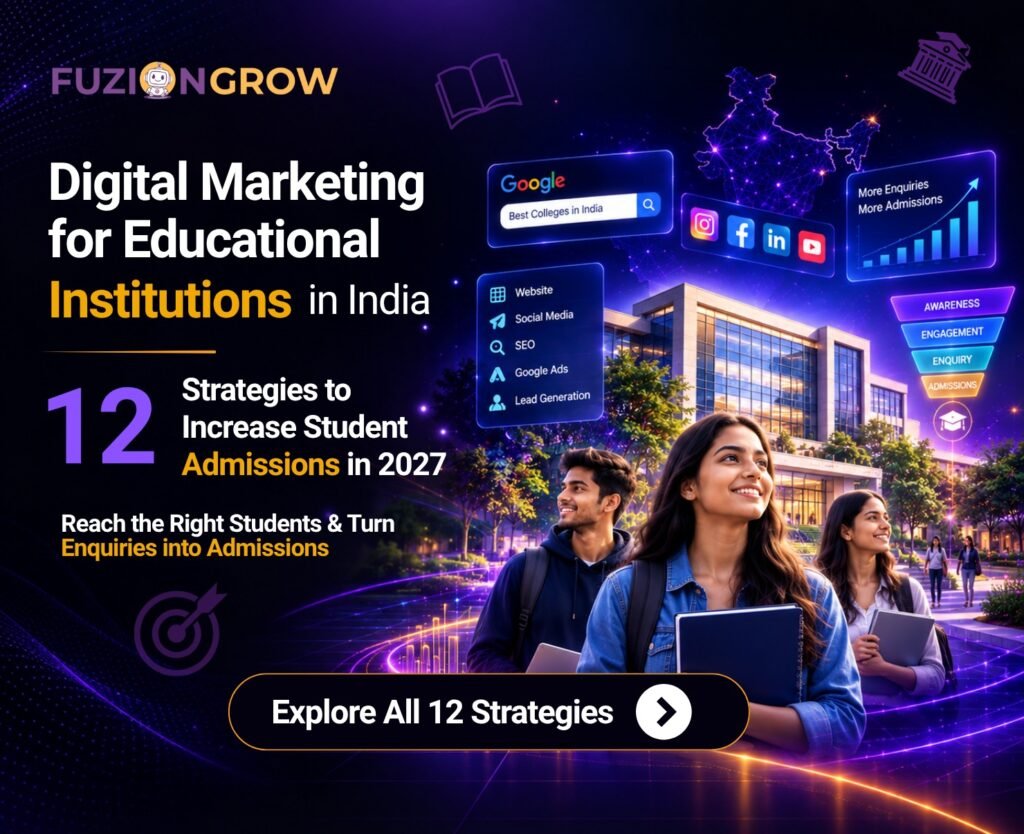
A college can have an excellent campus, experienced faculty, and strong placement records and still struggle to generate enough applications.
The problem is often not the institution itself. It is visibility, positioning, trust, and follow-up.
Students and parents now research courses, compare institutions, check reviews, watch videos, look at campuses, search for fees, and speak to counsellors before making an admission decision. Traditional brochures, education fairs, and newspaper advertisements can still have a place, but they are difficult to connect directly to applications and admissions.
That is where digital marketing for educational institutions becomes important.
The objective should not be “get more traffic” or “generate cheap leads.” Those numbers can look impressive while the admissions office remains under pressure.
The real objective is simple:
Reach the right student → build trust → generate a qualified enquiry → support the application → convert the applicant into an enrolled student.
Digital marketing for educational institutions is the use of SEO, Local SEO, content marketing, social media, Google Ads, video, email, WhatsApp, and conversion tracking to attract prospective students and parents, answer their questions, build confidence, and move them from online discovery to enquiry, application, and admission. The strategy should connect marketing activity with actual enrolment outcomes rather than stopping at clicks or leads.
A useful digital marketing strategy for educational institutes starts by mapping the complete student journey instead of treating every channel as a separate activity.
| Funnel stage | Student action | Best channels | Primary KPI |
|---|---|---|---|
| Discovery | Finds the institution or course | SEO, Google Maps, YouTube, Instagram, Facebook | Relevant reach |
| Comparison | Compares courses, fees, outcomes, and credibility | Website, reviews, videos, blogs, campus pages | Engaged visits |
| Enquiry | Requests information or speaks with the institution | Landing pages, forms, WhatsApp, calls | Qualified enquiries |
| Application | Starts or completes an application | Email, WhatsApp, CRM, counsellor follow-up | Applications |
| Admission | Confirms enrolment | CRM, counselling, remarketing, direct follow-up | Cost per admission |
This distinction matters.
A campaign generating 800 leads is not automatically better than one generating 250 leads. What matters is how many of those leads are relevant, how many apply, and how many finally enrol.
Google Ads now supports lead journey concepts such as qualified leads and converted leads, allowing institutions to connect online advertising with qualification and offline outcomes in their CRM or internal lead process.
That is the level of measurement an admission-focused strategy should aim for.
One of the easiest mistakes to make is sending every visitor to the homepage.
A student searching for “BBA college in Chennai” does not necessarily want to figure out where the BBA information is hidden inside a generic homepage.
Build dedicated pages for:
Each page should answer the questions that influence the decision:
What is the course? Who is it for? Why this institution? What are the eligibility requirements? What does it cost? What happens after graduation? How can I apply?
Google’s guidance for Google Ads specifically stresses alignment between the ad, keyword, and landing page. A visitor should find what the advertisement promised immediately after clicking.
This is a core part of marketing strategy for educational institutes, because the landing page is where interest turns into action.
Broad keywords are often less useful than specific searches.
For example:
The strategy should cover three keyword layers:
What programme does the student want?
What outcome is the student trying to achieve?
Where does the student want to study?
Good educational marketing strategies connect these layers instead of producing random blog posts.
A useful content structure might be:
Course page → Career guide → Comparison article → Fees/eligibility page → Admission page
The content should answer the user’s actual decision rather than repeating keywords. Google recommends using the language searchers use while keeping the content useful and people-first.
For schools, colleges, and coaching centres with physical campuses, Local SEO is not optional.
Students and parents search for things such as:
Google says local results are mainly influenced by relevance, distance and prominence, and recommends keeping Business Profile information complete and accurate. Reviews and links from other websites are among the signals associated with prominence.
For each eligible campus, optimise:
Do not create fake locations just to rank in more areas. That creates a bigger problem than the ranking opportunity is worth.
Content marketing for colleges should not mean publishing one blog post every week and hoping traffic increases.
Build content around the questions students ask at different stages.
This makes your online marketing strategies for educational institutions much more useful because each piece of content has a job.
One message for everyone is lazy marketing.
Students and parents may be looking at the same institution but asking completely different questions.
Your ads, landing pages, and content should reflect those differences.
This becomes particularly important in digital marketing for colleges, where the student may initiate the search but the family may strongly influence the final decision.
Education is a high-trust purchase.
People cannot physically experience a degree before buying it, so they look for signals that reduce uncertainty.
Useful formats include:
Do not manufacture testimonials or make unsupported placement claims.
A basic phone-shot video featuring a genuine student explaining why they chose the institution can be more credible than a heavily scripted corporate advertisement.
For marketing ideas for educational institutes, authenticity usually matters more than production complexity.
Google Search is particularly useful when someone already knows what they want.
Potential high-intent searches might include:
Separate campaigns by intent rather than throwing every keyword into one campaign.
Create dedicated landing pages for major programme groups.
Your ad should reflect the query, and your landing page should continue the same message. Google recommends relevant ad-to-keyword alignment and landing-page matching as important parts of Search campaign quality.
Google’s current Responsive Search Ads also allow multiple headlines and descriptions to be tested in combinations, helping match messages to search queries.
Meta Ads should not simply duplicate Google Search.
Use them for jobs that social platforms handle well:
For example:
Google Search: capture someone actively searching for an MBA college.
Instagram/Facebook: show that person student stories, campus videos or a programme-specific message later.
This combination is stronger than relying on one platform.
Good social media marketing for educational institutions, programme should mix proof, education, and promotion rather than making every post “Apply Now”.
A strong social media marketing for educational institutions plan should have recurring content pillars.
For regional institutions in South India, consider regional-language or bilingual content where it matches the audience. Search and ad campaigns should also reflect local terminology instead of assuming every user searches in formal English.
Generating the enquiry is only half the job.
A prospective student may need:
Build a simple follow-up sequence.
Immediately: enquiry confirmation
Same day: counsellor contact
Day 1–2: course information + FAQs
Day 3–5: testimonial or campus video
Day 6–10: fee/scholarship information
Later: reminder about application deadlines
The exact sequence should depend on the institution and admission cycle.
Slow follow-up can destroy the value of an otherwise good advertising campaign.
Your marketing plan for an educational institute should therefore include the admissions team, not just the marketing team.
Before submitting an application, people often check what others say.
Ask genuine students, parents, and alumni for honest reviews after meaningful experiences. Respond professionally to both positive and negative feedback.
Do not:
Reputation is cumulative.
An institution with polished advertisements but poor public feedback creates a credibility gap that marketing cannot easily fix.
This is where many education campaigns fail.
A dashboard showing:
Clicks → Leads → CPL
is incomplete.
You need to know:
Leads → Qualified Leads → Applications → Admissions → Revenue
Google Analytics now distinguishes key events from advertising conversions, allowing important actions to be measured and, where appropriate, used for advertising optimisation.
For education, examples of trackable actions include:
There is no single coaching institute marketing strategy or school marketing formula that works for everybody.
The decision is strongly parent-driven.
Prioritise:
The journey is more research-heavy.
Prioritise:
This is where digital marketing for colleges needs to be closely tied to each programme rather than marketed only at the institutional level.
Search intent can be extremely specific.
Prioritise:
A strong coaching institute marketing strategy should also distinguish students preparing for different exams rather than treating every learner as one audience.
Lead with outcomes and practical value:
The funnel is more digital from end to end.
Focus heavily on:
Here is a practical sample marketing plan for educational institute teams that need to move from scattered activity to a structured system.
Define:
Do not change these definitions every week.
Create:
Publish:
Start with high-intent searches, separate campaigns by programme or intent, and use landing pages that directly match the ad promise. Google recommends building relevant ad groups and using relevant ad assets and landing pages.
Now look beyond traffic.
Analyse:
Then reallocate budget.
Do not keep spending simply because a campaign produced many leads.
Use simple formulas.
Cost Per Qualified Lead = Marketing Spend ÷ Qualified Leads
A low CPL means little if the leads are irrelevant.
Enquiry-to-Application Rate = Applications ÷ Qualified Enquiries × 100
This shows how effectively the institution moves interested prospects into applicants.
Application-to-Admission Rate = Admissions ÷ Applications × 100
This helps identify whether the real problem is marketing, counselling, pricing, eligibility, competition or the programme offer.
Cost Per Admission = Marketing Spend ÷ Admissions Attributed to Marketing
This is far more useful than looking only at cost per lead.
Channel Revenue = Attributed Admissions × Revenue per Admission
Use a consistent attribution method and avoid pretending every admission came from one touchpoint.
Measure:
Enquiry received → First meaningful counsellor contact
This metric is often ignored, even though poor follow-up can waste paid traffic.
Google’s lead journey tools are specifically designed to help advertisers connect generated leads with offline qualification and closed outcomes.
Different audiences have different concerns. Segment them.
The homepage is rarely the strongest conversion page for a specific course or admission intent.
Cheap leads can be completely worthless.
A regional institution cannot afford to optimise only for generic national terms.
Nobody wants an endless stream of “Admissions Open” posts.
Teach first. Prove credibility. Then ask for the enquiry.
A lead sitting unanswered in a spreadsheet is not a marketing success.
If your marketing platform cannot distinguish an enquiry from an actual enrolment, your reporting is incomplete.
The biggest reason to work with a specialist agency is not that an agency can “run ads.”
Most agencies can run ads.
The harder part is connecting:
Search demand → landing page → enquiry → counselling → application → admission
Fuzion Grow’s approach should therefore be built around the institution’s admission objectives rather than a collection of disconnected services.
That means coordinating:
The important buyer question is not:
“How many leads will you give us?”
Ask:
“How will you determine which leads are worth pursuing, how will you track applications, and how will you connect marketing spend to admissions?”
Any agency unwilling to discuss those numbers is giving you an incomplete service.
Fuzion Grow can position its digital marketing services for educational institutes around that complete operating system rather than selling isolated channel packages.
Digital marketing for educational institutions works best when marketing and admissions stop operating as separate departments.
The winning framework is straightforward:
Discovery → Comparison → Enquiry → Application → Admission
Build the right course pages. Target genuine search demand. Show real proof. Use paid advertising where intent is strong. Follow up quickly. Track what turns into admissions.
That is a much better investment than simply buying more traffic.
For institutions that want an experienced team to build and manage this system, Fuzion Grow can position its service around the full admission funnel—not just SEO reports, social posts or lead numbers.