
A manufacturing company can have excellent products, experienced engineers and a strong sales team and still struggle to generate enough qualified enquiries.
The problem is often not the product. It is visibility.
A buyer looking for an industrial component, OEM supplier, machinery manufacturer, fabrication partner or contract manufacturer may begin with Google, review supplier websites, compare specifications, check certifications, look at case studies and only then contact sales. Gartner reported in 2025 that 61% of B2B buyers preferred an overall rep-free buying experience, while 73% said they actively avoid irrelevant seller outreach.
That changes what manufacturers need from marketing.
Digital marketing for manufacturers is not about posting more content or running random advertisements. It is about helping the right buyer discover your company, understand your capabilities, trust your expertise and take the next commercial step.
For Indian manufacturers, that can mean more product enquiries, RFQs, distributor conversations, OEM opportunities and export leads.
The most effective digital marketing for manufacturers usually combines technical SEO, conversion-focused website pages, useful industrial content, Google Ads for high-intent searches, LinkedIn and account-based campaigns, strong proof such as certifications and case studies, and proper lead tracking. The objective is not more traffic. It has more qualified B2B opportunities.
Manufacturing marketing is not the same as marketing a consumer product.
An industrial buyer may need to understand:
That means generic promotional copy usually performs poorly.
A manufacturing website that says “We are a leading company offering high-quality solutions” tells a serious buyer almost nothing.
A useful page tells the buyer exactly what the company manufactures, who it serves, what problems it solves, what standards it follows and what action the buyer should take next.
This is also why the website matters so much. Gartner reported that 76% of B2B buyers said they would avoid suppliers that provide a poor website experience.
The lesson is simple: your website is part of your sales process, not just your online brochure.
A practical digital marketing strategy for manufacturers normally has several connected parts rather than one isolated channel.
SEO helps your company appear when potential customers actively search for products, suppliers, applications or manufacturing capabilities.
Instead of targeting only broad phrases, an effective SEO programme builds around search intent.
For example:
Product intent
Commercial intent
Application intent
Problem intent
This is the difference between traffic and useful traffic.
The goal of SEO for manufacturing companies should be to attract people who could realistically become customers.
Google itself recommends creating helpful, reliable, people-first content and using the terms people actually search for in prominent parts of a page.
Many manufacturers make a basic website mistake: they list products but do not build pages around the questions buyers actually ask.
A strong product page should explain:
This supports SEO and improves the buyer experience at the same time.
Content marketing for manufacturers should not mean publishing generic blogs every week.
Create content around actual purchasing questions.
Examples:
This type of technical content can bring in prospects before they are ready to submit an enquiry.
It also gives your sales team something useful to share with prospects.
SEO is valuable, but it takes time.
Google Ads can help manufacturers reach buyers already searching for specific products or suppliers.
The important point is targeting.
A campaign built around broad keywords can waste a budget quickly. A focused campaign might target searches such as:
[product] manufacturer India
[product] supplier India
custom [product] manufacturer
OEM [product] manufacturer
Then send those visitors to a landing page specifically built for that search.
FuzionGrow’s own published marketing approach makes the same broader point: advertising works better when the website, offer, positioning and conversion path are already working together rather than treating ad spend as the entire strategy.
Industrial B2B marketing often involves multiple decision-makers.
The buyer may not be one person. It could involve procurement, engineering, operations, quality, plant management and senior leadership.
LinkedIn can therefore be useful for:
But posting company updates every day is not a strategy.
A better approach is to publish content that proves competence.
For example:
Weak:
“We manufacture high-quality industrial components.”
Stronger:
“Three factors that affect dimensional consistency in precision-machined components—and what buyers should check before approving a supplier.”
The second one gives a potential buyer a reason to stop.
B2B marketing for manufacturers becomes more powerful when you know exactly which accounts you want.
Suppose your company wants to sell to:
Instead of waiting for everyone to find you, you can build targeted campaigns around selected accounts and buyer roles.
The strategy can combine:
SEO + content + LinkedIn + paid search + email + sales outreach
The point is coordination.
One account may first discover your company through Google, read a technical page, see your LinkedIn content, revisit your website and later contact your sales team.
That is a much more realistic buying journey than assuming one advertisement will generate a purchase.
This is one of the most underestimated parts of marketing for manufacturers.
You can rank in Google and still lose the enquiry.
Why?
Because the visitor reaches the website and cannot quickly answer:
What do you manufacture?
Can you handle my requirements?
Why should I trust you?
How do I contact you?
Gartner’s B2B research has repeatedly highlighted the importance of websites in digital buying journeys, including the need to help buyers evaluate solutions without requiring constant interaction with sales.
For a manufacturer, conversion elements can include:
Do not hide the enquiry form under three menus.
Make the next step obvious.
Manufacturers often think local SEO only applies to restaurants, clinics and retail stores.
That is too narrow.
A manufacturer serving a particular industrial region can benefit from location-focused search visibility, especially when buyers search by city, industrial cluster or service area.
Examples include:
Google says local visibility is influenced by relevance, distance and prominence, while complete and accurate business information helps Google understand and display a business profile.
For manufacturers, the bigger opportunity is often not just “near me” searches. It is creating strong location and capability pages for genuine markets served.
There is a lot of noise around “GEO” and “AI SEO.”
The basic principle is simpler than the marketing industry makes it sound.
Make your information clear enough that search systems can understand it.
Your pages should clearly state:
Use descriptive headings, straightforward answers, structured information, strong internal links and original content.
Google’s current guidance says there are no special technical requirements or separate optimisation systems required specifically to appear in AI Overviews or AI Mode; the fundamental SEO practices still matter.
Google also recommends valuable, non-commodity content with a genuinely useful point of view instead of simply recycling information found elsewhere.
That matters for manufacturers because technical knowledge is your advantage.
A generic agency can rewrite “what is CNC machining?”
A manufacturer can explain a real production consideration buyers need to understand.
That is much more defensible content.
One of the worst manufacturing marketing mistakes is celebrating traffic without checking what happened afterward.
A better measurement framework looks like this:
| Stage | Metric |
|---|---|
| Visibility | Search impressions |
| Traffic | Organic clicks / paid clicks |
| Engagement | Relevant page visits |
| Intent | Product-page visits |
| Lead | Enquiry / RFQ |
| Qualification | Marketing-qualified lead |
| Sales | Opportunity |
| Revenue | Closed business |
A manufacturing marketing strategy should eventually connect marketing activity to the pipeline.
A thousand visitors are irrelevant if none are potential buyers.
Twenty highly relevant visitors who produce three serious RFQs may be far more valuable.
A practical plan can be built in five stages.
Identify:
Build keyword groups around:
Products → Applications → Problems → Suppliers → Locations → Commercial searches
Do not create a separate blog for every tiny keyword variation.
Create useful pages that cover a genuine search topic comprehensively.
Before pushing more traffic, review:
Combine:
The exact mix depends on the product, sales cycle and target market.
Connect website enquiries to the CRM or sales process.
Without that connection, you cannot properly judge whether your marketing is producing business or merely activity.
There is no honest single number.
A manufacturer targeting ten local searches with a small product range needs a different programme from an industrial company targeting hundreds of product terms across India and export markets.
Your budget usually depends on:
Do not choose an agency simply because it offers the lowest monthly package.
The better question is:
What business problem is the agency solving, what exactly will it deliver, and how will success be measured?
That is far more useful than comparing retainers line by line.
SEO does not produce leads overnight. Google needs time to crawl, understand and evaluate your website, while your pages need useful content and authority to compete.
A better way to measure progress is:
Technical SEO → Search visibility → Relevant traffic → Enquiries → Qualified leads → Sales pipeline
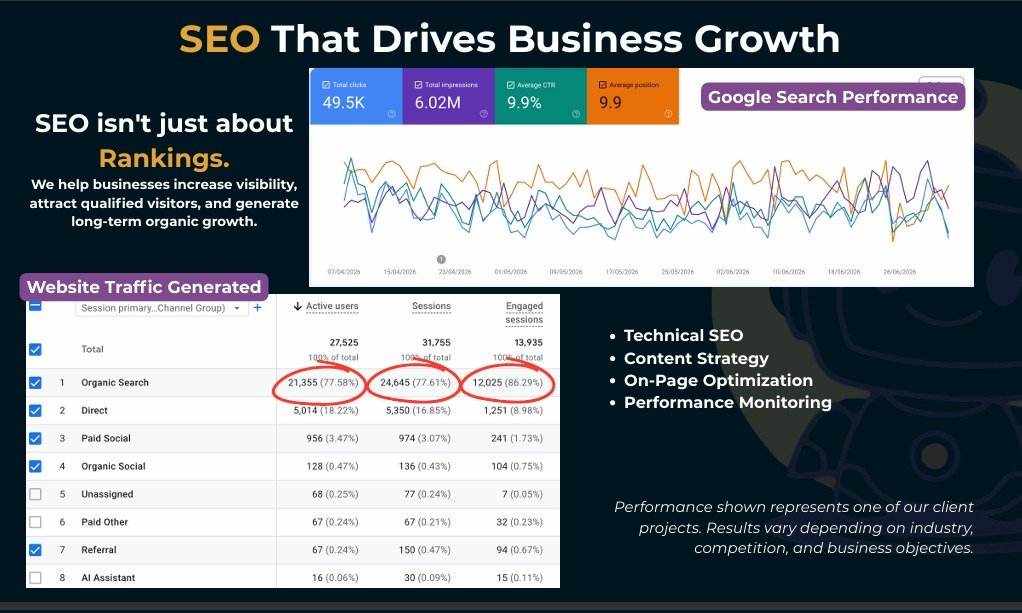
FuzionGrow’s client SEO reporting has publicly shown 19.3K+ Google Search impressions, 1.82K+ organic clicks and a 9.4% average CTR. These are company-reported results, not independently audited figures, and performance varies by industry, competition and business goals.
The key is to measure business impact, not rankings alone. A higher ranking means little if it does not attract the right buyers and generate genuine enquiries.
FuzionGrow publicly describes its approach as combining AI with human expertise across SEO, web design, PPC, social media and data-driven marketing.
For a manufacturing company, the more useful part is not the list of services.
It is whether those services are connected.
A manufacturer does not need:
SEO → separate
Website → separate
Ads → separate
Social media → separate
It needs one growth system:
Search visibility → useful website experience → trust → enquiry → sales follow-up
That is also consistent with FuzionGrow’s publicly shared philosophy that marketing channels work better when they support the same customer journey rather than operating independently.
Do not increase ad spend just because leads are weak.
First check:
Audience → Offer → Website → Trust → Conversion path
If one of those is broken, adding more traffic can simply increase waste.
That is a much more useful conversation for a manufacturer than “How many posts will you publish every month?”
The biggest mistake a manufacturer can make is treating digital marketing as a collection of disconnected activities.
Publishing blogs does not automatically create leads.
Running Google Ads does not automatically create sales.
Having a modern website does not automatically create enquiries.
And ranking for broad keywords does not automatically mean you are reaching the right buyers.
Effective digital marketing for manufacturers connects the entire journey:
Right audience → right search → useful information → credible website → clear enquiry path → qualified lead → sales opportunity
That is what manufacturers should expect from an agency.
FuzionGrow is positioned around that broader growth model, combining SEO, websites, paid marketing, content, social media and analytics rather than treating each channel as an isolated service.
For a manufacturing business, the decision should therefore not be “Should we do digital marketing?”
The better question is:
“Can our current digital presence consistently put us in front of the right industrial buyers and turn that attention into qualified business enquiries?”
If the answer is no, the problem is worth fixing, and it starts with a strategy built around your products, buyers, markets, and sales process rather than a generic marketing package.