
A startup does not need more marketing activity. It needs more qualified leads and customers.
You can get 10,000 website visitors and still make no sales. The real question is not how much traffic you generate, but whether the right people find you, trust you, and take action.
The best digital marketing strategies for startups focus on high-intent searches, useful content, strong offers, fast lead follow-up, and measurable conversions. This helps startups spend less on activities that create attention but fail to create revenue.
If your goal is to generate consistent leads, reduce wasted marketing spend, and build a predictable customer acquisition system, the strategy should start with customer intent, not vanity metrics.
The most effective approach combines high-intent SEO, founder-led content, targeted outbound, lead magnets, automation, email nurturing, social listening, short-form video, and retargeting. Start with one primary acquisition channel, measure qualified leads and conversions, then scale what produces revenue.
The old model was simple: get traffic, increase followers, and generate awareness.
That is not enough anymore.
A serious startup marketing strategy should answer four questions:
This changes how you choose channels.
A channel producing 20,000 impressions but zero sales is not necessarily successful. A channel producing 30 highly qualified leads with five customers may be far more valuable.
This is why startups should avoid trying every platform at once. Limited budgets and small teams make focus more important.
HubSpot’s current startup guidance similarly emphasizes focused goals, buyer personas, SEO, content distribution, paid acquisition, reputation, and lifetime value rather than spreading resources randomly.
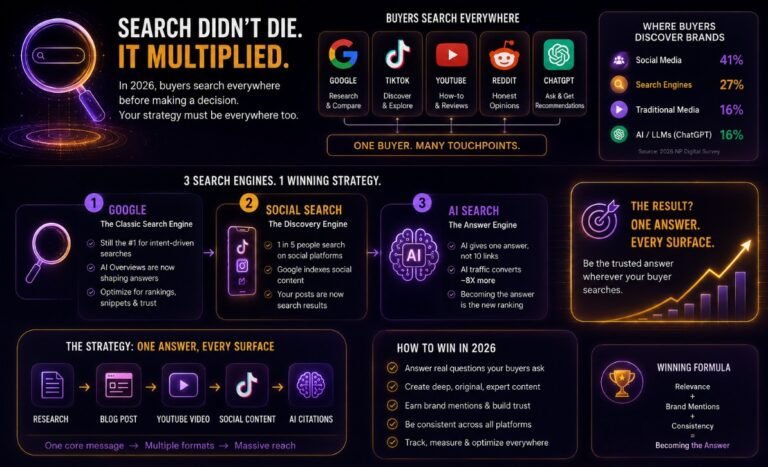
Search is no longer limited to Google.
Potential customers may discover a startup through Google, YouTube, TikTok, Reddit, LinkedIn, or AI tools such as ChatGPT. They might discover your brand on social media, research it on Google, check reviews or Reddit discussions, and then ask an AI tool which option is best.
That means startups should not focus on ranking in just one place.
The goal is to become a trusted answer wherever your customers search.
Instead of creating completely different content for every platform, create one strong answer and adapt it across channels.
For example:
One research topic → blog post → YouTube video → LinkedIn post → short-form videos → FAQ content
The core message stays consistent while the format changes.
Google’s current guidance confirms that the same fundamental SEO practices remain relevant for AI Overviews and AI Mode. There is no separate magic optimization required; useful content, crawlability, internal links, and strong page experience still matter.
Good topics include:
This makes content marketing for startups useful across traditional search, social search, and AI-driven search.
Your website, social profiles, reviews, videos, and online mentions should communicate the same positioning.
The practical takeaway is simple: don’t try to be everywhere with completely different messages. Build one strong, evidence-based message and distribute it where your customers actually search.
Customers discover startups through Google, social media, communities, and AI search. Create content that directly answers real customer questions and high-intent searches. Keep your website, profiles, reviews, and content consistent and trustworthy.
The goal: be visible and credible wherever your customers search before buying.
Cold outreach becomes much more effective when you stop contacting people randomly.
Look for signals that suggest a company may actually need your solution.
Examples include:
For example, if a startup is hiring a large sales team, it may soon need better lead generation, CRM systems, or marketing support.
That is a stronger reason to contact them than simply finding their email address.
The principle is straightforward: sell when there is evidence of a problem, not simply because you have a service to sell.
SEO can be one of the most valuable long-term digital marketing strategies for startups, but only if you target the right searches.
Do not build your entire strategy around broad keywords with huge search volumes.
Prioritize searches showing commercial intent:
For example, someone searching “what is digital marketing” is still learning.
Someone searching “digital marketing agency for SaaS startups” is much closer to contacting a provider.
That difference is critical.
Your content marketing for startups should therefore connect educational content with commercial pages, case studies, service pages, and clear calls to action.
Google recommends useful, original, and people-first content, while also emphasizing clear organization and internal linking.
A 40-page PDF is not automatically a valuable lead magnet.
Startups can often generate stronger engagement with something useful immediately.
Try:
The important part is what happens next.
Someone completes an assessment → submits contact details → receives useful results → gets a relevant recommendation → can book a consultation.
That creates a natural sales journey.
The lead magnet should solve a small problem while making the larger problem—and your solution clear.
People often trust people before they trust companies.
A founder can share:
LinkedIn, YouTube, X, and relevant communities can all work.
The content does not need to be polished like a corporate advertisement.
In fact, overly polished content can make a young company look less authentic.
Talk about real problems. Show what you know. Explain your reasoning.
That is one of the best marketing strategies for startups because expertise can become a competitive advantage even when the company cannot compete with larger brands on advertising budgets.
One of the biggest mistakes in SEO is chasing traffic instead of buying intent.
Consider searches such as:
These searches are valuable because the person already understands the problem.
Your job is to help them make a decision.
For digital marketing strategies for small business, the same principle applies: fewer high-intent visitors can be more valuable than thousands of irrelevant visitors.
SEO for startups should therefore be organized around search intent, commercial relevance, and conversion potential, not search volume alone.
Imagine someone fills out your form at 10:30 AM.
If your company responds at 5 PM, that prospect may already have contacted three competitors.
Speed matters.
Connect your website forms with:
A basic workflow could be:
Lead submits form → CRM records lead → sales notification → instant email/WhatsApp response → calendar link → sales follow-up
This is one of the simplest digital lead generation strategies to improve without dramatically increasing traffic.
The point is not to automate everything. It is to remove unnecessary delays between interest and response.
Instead of constantly publishing promotional posts, find people already discussing the problem you solve.
Look at:
If people repeatedly ask, “Why are my Google Ads leads poor quality?” that is a content opportunity.
Create an honest answer.
If people ask, “How much does SEO cost for a startup?” answer it clearly.
If people complain about poor agency reporting, explain what a good reporting system should contain.
This approach produces marketing strategies for startups based on real customer language instead of assumptions.
Short-form video should not exist only to collect views.
Use it to move people toward a business action.
Good formats include:
Then use a clear CTA:
Watch → understand → trust → visit landing page → enquire/book/demo
A successful digital marketing campaign does not need every video to go viral.
It needs the right viewers to take the next step.
Not every lead is ready to buy today.
That does not mean the lead is worthless.
Create sequences based on behavior:
Someone who downloaded an SEO checklist should not necessarily receive the same emails as someone who visited your pricing page three times.
Behavior gives you context.
Use that context to make your online marketing strategy more relevant.
The objective is not to send more emails. It is to help qualified prospects move closer to a buying decision.
Most visitors will not convert on their first visit.
That is normal.
Instead of retargeting everyone, segment visitors according to intent.
For example:
Service-page visitor: show a case study or consultation offer.
Pricing-page visitor: show proof, FAQs or a clear offer.
Lead-magnet user: show a related service.
Abandoned form: encourage them to complete the enquiry.
This makes retargeting more useful than repeatedly showing the same generic advertisement.
The right digital marketing agency is not the one offering the most services. It is the one that understands your target customer, sales cycle, budget, and growth goal. Research also supports starting with a focused strategy rather than spreading resources across too many channels.
Before choosing an agency, check:
For example:
Don't hire an agency because it promises to "do everything." Hire one that can identify where your customers are, test the right strategy, measure results, and scale what actually generates business.
A practical startup marketing plan should grow with the business.
Focus on:
These are among the most practical low-cost marketing strategies for startups because they rely more on expertise and consistency than large advertising budgets.
Add:
Invest in:
Do not scale a channel simply because you have money.
Scale it because the numbers show that it can acquire customers profitably.
Keep it simple.
Know exactly who has the problem, who makes the buying decision and why they would pay for your solution.
Do not split a ₹50,000 budget across six channels before knowing what works.
Make the next step obvious.
That could be a consultation, demo, audit, trial, assessment or product purchase.
Your page should quickly explain:
Do not let enquiries sit inside an inbox.
Connect forms, CRM, notifications, and follow-ups.
Traffic is useful only when it contributes to business growth.
This is where startups should become aggressive.
Once you know where profitable customers are coming from, invest more there
Choosing a startup marketing agency is not about finding the agency with the longest service list. It is about finding a team that can turn strategy into measurable growth.
FuzionGrow combines SEO, performance marketing , social media, branding, websites and funnels, AI, and automation to help businesses build a connected digital marketing system.
FuzionGrow reports:
These numbers are useful as credibility signals, but they should not be the only reason to choose an agency. What matters is whether the team can connect marketing activity → qualified leads → conversions → business growth.
Before hiring, ask for:
Avoid agencies promising guaranteed rankings, instant results, or huge traffic numbers without explaining how those metrics will generate customers.
The best digital marketing strategies for startups focus on business results, not marketing activity.
Start with one acquisition channel, one organic channel, one clear offer, and one conversion-focused landing page. Follow up quickly and track qualified leads, conversions, CAC, and revenue.
Stop spending on channels that bring traffic but no customers.
If you need help building the right strategy, FuzionGrow can help you choose the right channels and turn them into a measurable lead-generation system